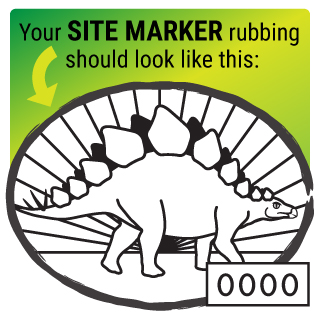
Stegosaurus
Difficulty: Easy  Distance: 0.50 miles
Restrooms: No
Stroller Friendly: Yes
Wheelchair Friendly: No
Playground: No
Dog Friendly: No
Location: Tuscarora Wildlife Education Project
Distance: 0.50 miles
Restrooms: No
Stroller Friendly: Yes
Wheelchair Friendly: No
Playground: No
Dog Friendly: No
Location: Tuscarora Wildlife Education Project
Clues for Your Hike
- Start at the back of the building with the bench by the goldfish pond on your left and walk toward the sign that says, “Main Trail.” At the T junction, turn left.
- Cross the road and continue straight down the dirt road. Turn left at the Groundhog Trail sign.
- Keep the Groundhog Trail signs on your left and keep left, walking toward the pavilion.
- Walk past the pavilion and the green shed on the left.
- Stop and read about Bird Houses on the left and then continue following the path as it curves right.
- Stay left at the fork and keep the stream on your left.
- Continue straight passing the Charlies Trail sign on the left.
- Turn right after the wooden amphitheater and follow the path, passing the Main Trail sign and the bench on your left.
- Turn right, back on the Groundhog Trail and head back toward the pavilion.
- Turn left in front of the pavilion and follow the path up a short hill. A pile of wood is on your right.
- The post is on the tree to the left before the gravel road.
- To return to your vehicle, cross the road, turn left and follow the gravel road – watch for cars!
- Follow the gravel road for several yards and turn right on the grass path, walking up a slight hill. You will pass a large, low shrub on your left.
- Just past the River Birch sign on the right, follow the grass path to the left.
- Continue on the grass back to the parking area.
Did You Know?
- Stegosaurus, meaning “roofed lizard,” is an herbivorous four-legged armored dinosaur from the late Jurassic period.
- They have distinctive kite-shaped upright plates along their backs and spikes on their tails.
- Stegosaurus had a brain about the size of a walnut, and paleontologists once thought they had a brain in their butt.